
Server Core Separation and Remote Administration
One of the largest architectural changes made during the development of Mir Vengeance was the complete separation of the game server from its administration and content management tools.
Traditional Crystal-based servers typically combine game logic, administration tools, content editors, configuration screens, and operational controls into a single executable.
While convenient, this approach means that the game server itself is responsible for hosting functionality that is unrelated to processing gameplay.
Headless Server Architecture
The Mir Vengeance server has been redesigned around a headless architecture.
The game server’s primary responsibility is now limited to:
- Processing gameplay
- Managing player connections
- Running game systems
- Executing server logic
- Managing world state
The majority of legacy Windows Forms administration tools have been removed from the server process entirely.
Instead, the server operates as a dedicated game service with a lightweight monitoring interface focused on performance, health, and operational status.
Real-Time Server Monitoring
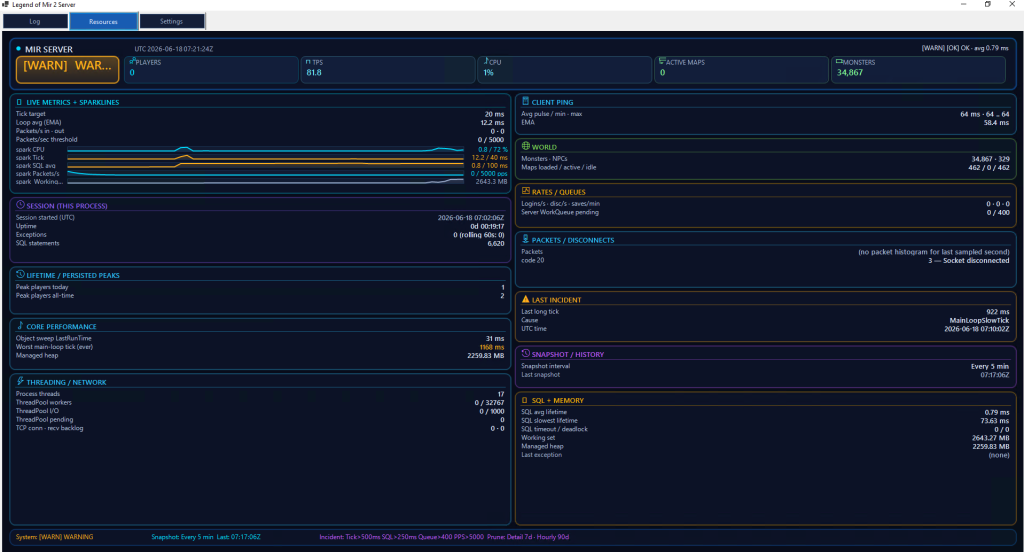
The new server dashboard provides live operational statistics including:
- Online players
- Server TPS
- CPU utilisation
- Active maps
- Monster populations
- SQL performance
- Network statistics
- Memory usage
- Queue processing
- Incident monitoring
This allows administrators to quickly identify performance issues without exposing content management functionality directly on the game server.
Remote Administration Platform
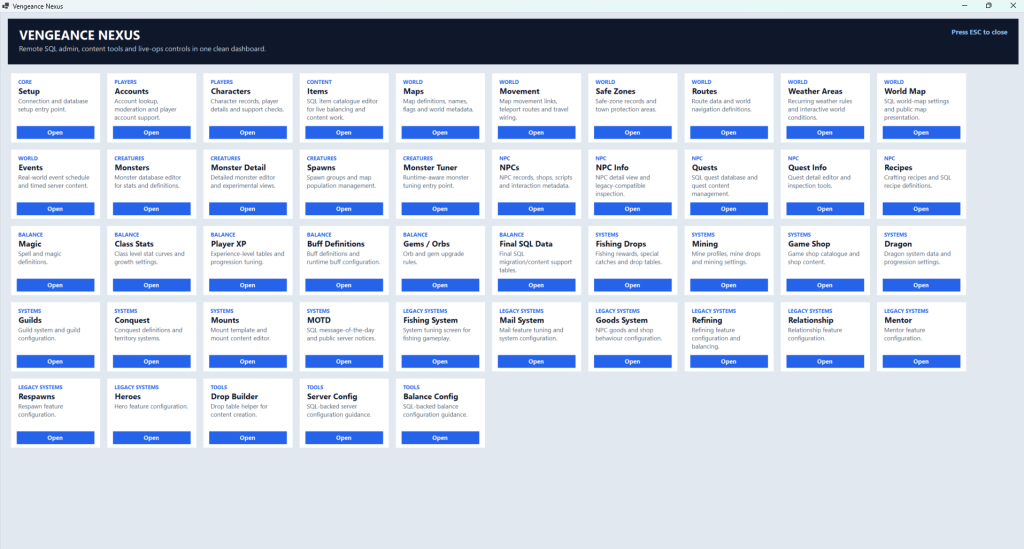
Administration, content management, balancing, and configuration tasks are performed through Vengeance Nexus, a dedicated remote management platform.
The Nexus platform connects securely to the server and provides access to tools such as:
- Account management
- Character management
- Item administration
- Monster databases
- Spawn management
- NPC management
- Quest systems
- Fishing configuration
- Mount configuration
- Guild configuration
- Balance tuning
- Content creation tools
By separating these functions from the live game server, operational tasks can be performed without increasing the complexity of the server process itself.
Reduced Attack Surface
A key advantage of this architecture is the reduction of the server’s administrative attack surface.
Because administration tools, editors, configuration screens, and content management systems no longer operate directly within the game server process, the server exposes significantly less functionality than traditional Crystal implementations.
The result is a cleaner separation between gameplay systems and administrative systems, reducing risk while improving long-term maintainability.
Built For Long-Term Operations
The separation between the game server and the remote administration platform allows both systems to evolve independently.
New administration tools, balancing features, content editors, and operational utilities can be developed within Vengeance Nexus without requiring fundamental changes to the live server process.
This architecture provides a more scalable foundation for future development while ensuring that the game server remains focused on its primary role: running the world of Mir Vengeance efficiently and reliably.